Driven to the Ground

There was a time when accusations of antisemitism carried enormous moral weight across the world. That weight existed for good reason. Antisemitism has a long and horrifying history, from centuries of persecution and exclusion to pogroms, ghettos, and ultimately the Holocaust. The term described a genuine and deadly form of racism that deserved to be confronted seriously and consistently wherever it appeared.
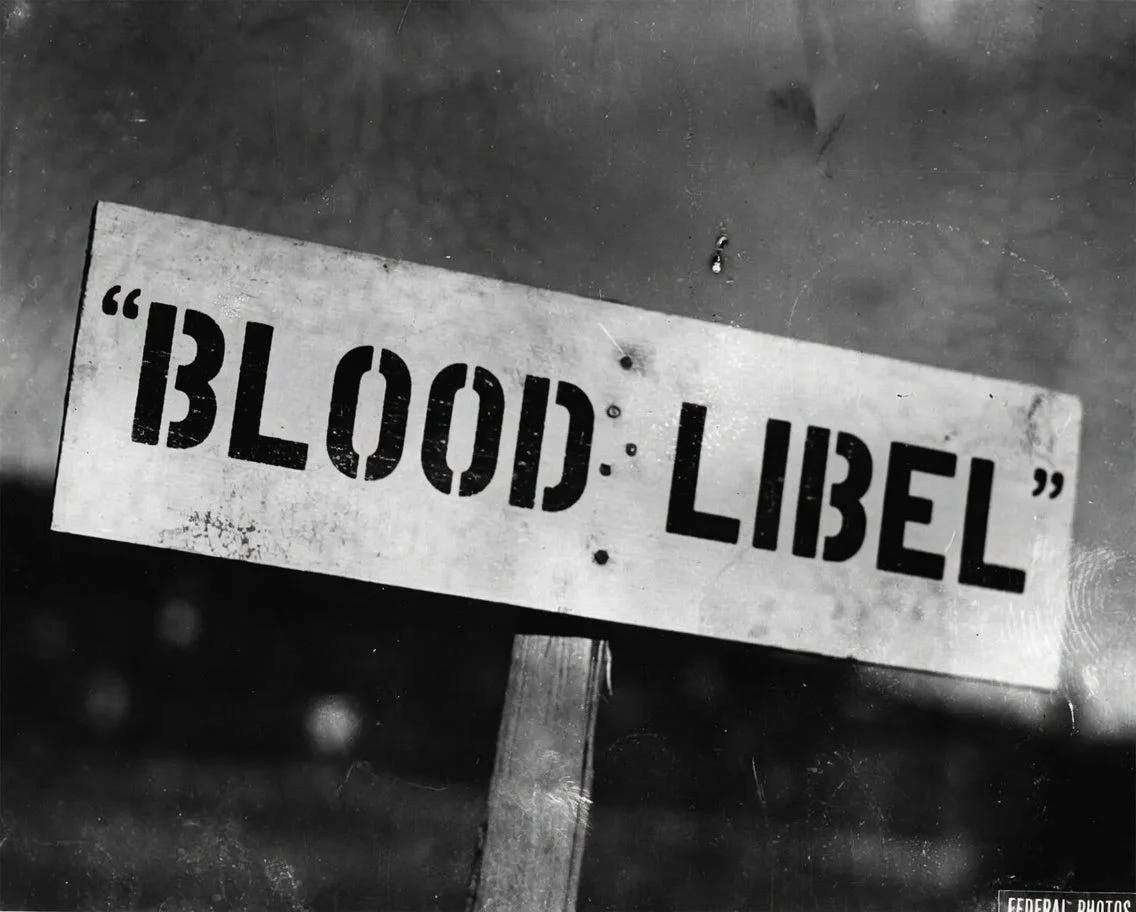
Likewise, the phrase “blood libel” referred to one of the ugliest myths in European history, the false accusation that Jewish people murdered Christian children for ritual purposes. It was a lie used to justify violence, discrimination and mass persecution against innocent people for centuries.
But in recent years, particularly in relation to criticism of Israel and its treatment of Palestinians, both terms have increasingly been used far beyond their historical meaning. Politicians, lobby groups, media commentators, Israeli officials, and bored lonely racist trolls now frequently label criticism of Israeli government policy as “antisemitic”, while descriptions of Israeli military conduct or allegations of war crimes are dismissed as “blood libel”.
This strategy is intellectually dishonest, and the repeated overuse of these accusations is eroding their power altogether, and we’re really getting sick of it.
When almost every criticism of Israel is branded antisemitic — whether it concerns settlement expansion, the blockade of Gaza, civilian deaths, forced displacement, apartheid allegations, or breaches of international law — many ordinary people begin to see the accusation not as a serious warning about racism, but as a political shield designed to silence criticism.
That perception is damaging on several levels. Firstly, it weakens the fight against real antisemitism. Actual antisemitism still exists. Synagogues are attacked. Jewish people are abused online and in public. Neo-Nazi movements still operate openly in many countries. Conspiracy theories about Jewish control and influence continue to circulate widely. These are genuine forms of racism that require vigilance and public condemnation.
But when the same label is applied indiscriminately to human rights organisations, United Nations officials, journalists, academics, student protesters, Holocaust scholars, former Israeli politicians, Jewish critics of Israel, and ordinary citizens calling for Palestinian rights, people inevitably become sceptical. The accusation begins to look less like a principled stand against racism and more like a rhetorical weapon.
Once that happens, the danger is obvious. If people start tuning out accusations of antisemitism because they believe the term is being manipulated for political purposes, then genuine cases may no longer receive the seriousness they deserve.
Secondly, the strategy damages Israel’s international credibility. For decades, Israel’s defenders benefited from substantial goodwill in many Western countries. The historical trauma of the Holocaust understandably shaped public sympathy and political support. But public opinion is changing rapidly, especially among younger generations who have grown up with instant access to footage, testimony, independent journalism and social media coverage from Gaza and the occupied Palestinian territories.
When people watch apartment blocks collapse, hospitals destroyed, refugee camps bombed, aid blocked, journalists killed and entire families wiped out, and then hear every expression of concern dismissed as “antisemitism” or “blood libel”, many conclude that Israeli officials are attempting to shut down moral scrutiny rather than answer legitimate criticism. And that’s exactly what they’re attempting to do.
And that reaction is intensified when the accusations are directed at respected international institutions and organisations.
The United Nations, Amnesty International, Human Rights Watch, Médecins Sans Frontières, genocide scholars, former diplomats, and even former Israeli military personnel have all raised serious concerns about Israeli policy at different times. Branding all such criticism as antisemitic stretches credibility to breaking point.
The term “blood libel” in particular has increasingly become counterproductive in modern political discourse. Historically, it referred to fabricated accusations against Jews involving ritual murder. Today, however, it is often invoked whenever reports emerge about civilian casualties, starvation, attacks on infrastructure, or allegations of human rights abuses in Gaza.
Yet many of these reports are not medieval fantasies or racist conspiracy theories. They are coming from international aid agencies, eyewitness accounts, satellite imagery, investigative journalists and humanitarian organisations operating on the ground.
People can debate interpretations, casualty figures, military intent and legal definitions. That is normal in any conflict. But reflexively labelling all allegations as “blood libel” risks trivialising the original historical meaning of the phrase while simultaneously making Israel appear unwilling to tolerate scrutiny.
There is also a broader communications failure embedded in this approach. Modern propaganda works differently than it did decades ago. Governments no longer control information flows in the same way. Millions of people now watch events unfold in real time through videos, independent reporters and social media platforms. Attempts to aggressively suppress criticism often backfire because they create the impression that uncomfortable truths are being hidden rather than answered.
The more frequently accusations of antisemitism are deployed against critics of Israel, the more some observers begin separating Jewish identity from the actions of the Israeli state entirely. Ironically, the over-politicisation of antisemitism accusations may actually accelerate the decline of Israel’s moral authority internationally because it reinforces the perception that the state relies on historical trauma as a protective barrier against accountability.
That is not sustainable. No country should be immune from criticism. Russia is criticised for Ukraine. China is criticised for Xinjiang. Saudi Arabia is criticised for Yemen. The United States is criticised for Iraq and Afghanistan. Israel cannot expect to conduct military operations, maintain an occupation, expand settlements, or impose blockades while insisting that criticism itself constitutes racism.
The world absolutely should oppose antisemitism wherever it exists. Jewish people should never be held collectively responsible for the actions of any government, or the 85% - 90% of Jewish Israelis who support the country's ongoing military campaigns or the 65% of the total global Jewish population who support Israel's military actions. But those numbers are quite telling, and may go some way to explaining the problem.
Precisely because antisemitism is real, the term must be protected from political overuse. We’ve driven these terms to the ground. If every critic becomes an antisemite, eventually the accusation loses meaning. And if every allegation of wrongdoing becomes “blood libel”, eventually people stop listening altogether.
In the long run, that may prove disastrous not only for public understanding of antisemitism itself, but also for Israel’s standing in the eyes of the world, which has already hit rock bottom.
